Dehydrated, nauseous, or can't keep fluids down?
IV Therapy for Altitude Sickness in Denver
Search "IV therapy for altitude sickness" in Denver and you'll find plenty of people willing to sell you one. Fewer are willing to tell you when it won't help. So here's the honest version first: an IV treats dehydration. It does not treat the low blood oxygen that actually causes altitude sickness, and it will not acclimatize you any faster. If you're mildly headachy and can still eat and drink normally, rest, fluids and one easy day will do the same job for free.
Where an IV genuinely earns its place is narrower — and if you're in it, you already know. You've been vomiting, or you can't drink enough to keep up, or you arrived depleted after a long travel day and a couple of drinks, and now you're losing a day of your trip to it.
When an IV genuinely helps
- You're vomiting or nauseated enough that you can't keep fluids down. Oral rehydration only works if it stays down.
- You're clearly dehydrated — dark urine, dry mouth, dizzy standing up — after a long flight, alcohol, or illness.
- You've fallen behind and can't catch up by drinking, and you have a day you need to function for.
In those situations, replacing fluid and electrolytes directly works faster than sipping, and most people feel meaningfully better within the hour.
When it doesn't
- It does not fix the oxygen deficit. Altitude sickness is caused by lower oxygen pressure. Fluids don't change that. Time at altitude, rest, and not going higher are what actually resolve it.
- It is not an acclimatization shortcut. No IV, oxygen bar, or supplement meaningfully speeds up the physiological adjustment. Anyone telling you otherwise is selling.
- It is not preventive. Getting an IV before you fly, or on arrival "just in case," has no evidence behind it.
- It is not the answer to severe symptoms. See the next section — that's the important part.
If you can drink normally and you're not vomiting, save your money and take an easy day.
We don't provide oxygen, and here's what that means
Intravene does not provide supplemental oxygen. We're telling you that up front because it matters clinically.
If your symptoms are severe enough that you need oxygen, that is a signal to descend or seek emergency care — not to book an IV.
Go to an emergency room or call 911 for:
- Shortness of breath while resting
- Confusion, extreme drowsiness, or trouble walking straight
- A cough with frothy or pink sputum, or chest tightness
- Blue or grey lips
- Oxygen saturation persistently below 88–90%
These can indicate high-altitude pulmonary or cerebral edema. Both are medical emergencies, and neither is treated with hydration.
Who actually shows up
The person who arrives matters more than what's in the bag.
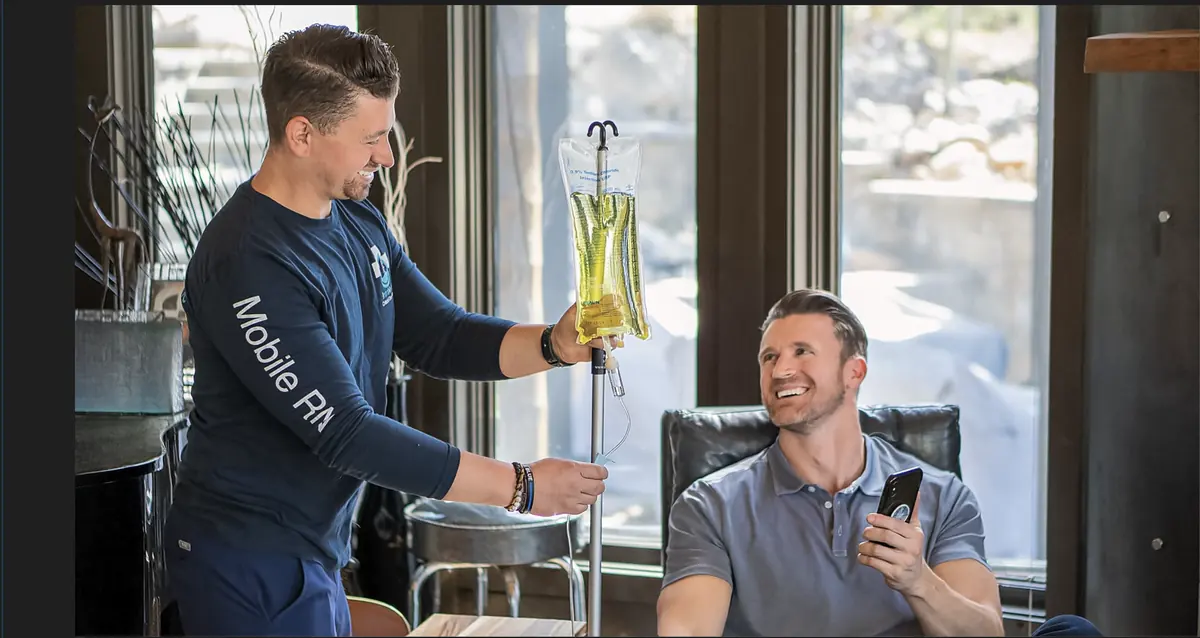
Intravene sends registered nurses with critical-care and emergency backgrounds — the same clinicians who run IVs in hospital settings, not wellness-spa staff. Treatments are overseen by a physician and nurse practitioners, and every visit is administered by a registered critical-care nurse.
Intravene operates under independent medical oversight from Guardian Medical Direction, a national physician-led medical direction group. Guardian provides medical oversight to medical spas, wellness centers, telemedicine companies and healthcare practitioners across the country, through a team of medical directors and physician collaborators.
Before anything is started, your nurse reviews your health history and checks your vital signs, and will tell you plainly if what you're describing sounds like something that belongs in an emergency room rather than a hotel room. Your vitals are checked again at the end of the visit. That conversation is part of the visit, not an upsell.
What's actually in the drip
Intravene's Altitude Sickness IV — one of their most-requested treatments in Denver — delivers fluids and electrolytes for rehydration, along with vitamins and anti-inflammatory medication for symptom relief.
What it is: rehydration and symptom relief, administered by a nurse, in your room. What it isn't: a detox, a cure, or a substitute for acclimatizing.
We'd rather undersell this than have you expect something it can't do.
How it works in Denver
- Call. (720) 802-5352 — you'll speak to someone who can tell you whether a visit makes sense for what you're describing.
- Give your location. Hotel room, rental, office, or home anywhere in the Denver metro.
- A nurse comes to you. Same-day appointments are often available; earlier calls get better windows.
- History and vitals first, then the drip if it's appropriate.
- About 45–60 minutes, and you can lie down the whole time.
What it costs
Straight answer: mobile IV therapy in Denver starts at $194 for hydration and recovery drips. Specialty formulas such as NAD+ start at $275, and the range runs to about $350+ at the top end. The in-home nurse visit is included — there's no separate call-out fee.
IV wellness therapy is generally not covered by insurance and is an out-of-pocket service. You'll be told the price on the first call, before anyone is dispatched.
Serving Denver
Nurses cover the Denver metro, including downtown and LoDo hotels, Cherry Creek, the Denver Tech Center, Capitol Hill, RiNo, Wash Park, Highlands, and the surrounding suburbs. If you're staying downtown after a late flight into DIA, that's the most common call we take.
Heading up to the mountains afterwards? Read Altitude Sickness in Colorado first — staging through Denver is the part most people skip.
Frequently asked questions
Does IV therapy actually help altitude sickness?
It helps with the dehydration that makes altitude symptoms worse, and it can relieve nausea and headache. It does not treat the low blood oxygen that causes altitude sickness — only time, rest, and not ascending do that. If you're vomiting or can't keep fluids down, it's a reasonable choice. If you can drink normally, it isn't necessary.
How much does IV therapy cost in Denver?
Drips start at $194 for hydration and recovery, with specialty formulas such as NAD+ from $275 and a top range around $350+. The in-home nurse visit is included in the price.
How fast can a nurse reach me in Denver?
It depends on your location and the time of day, but same-day appointments are often possible. Calling earlier in the day improves your odds.
Do you provide oxygen?
No. If your symptoms need oxygen, you need medical evaluation or descent, not an IV. The red-flag list above is the honest test.
Is it covered by insurance?
Generally no — IV wellness therapy is an out-of-pocket service. Pricing is given up front.
Should I get an IV before flying to Denver to prevent altitude sickness?
No. There's no evidence that pre-emptive IV hydration prevents altitude sickness. If you have a history of severe altitude illness, talk to your own doctor about prescription prevention before you travel. See How to Avoid Altitude Sickness in Denver.
Need a nurse in Denver today?
Same-day appointments often available. From $194, in-home visit included.